Sara Criss’ Civil Rights Memoir #21: War of Words

“In another article in the Greenwood Voice, Dick Gregory was quoted as saying, ‘I think you are doing a wonderful job here, I think its equal to Germany Berlin, Japan, Korea, in fact we should suppress all of that because it leaves a bad taste in my mouth to know that tomorrow I may be called to any of the 4 corners of the world to leave my family and perhaps losing my life, and fighting for here in Mississippi.’ Gregory was quoted further: ‘It’s illegal for the Agriculture Department to pick up the tab for the distribution of commodities here in Leflore County. I think it should be done double in the rest of the country because Mississippi has been a bad boy.’

“During the period of the marches to the Court House the mayor issued daily statements to the media. On April 1, 1963, a statement read: ‘The City Council is pleased that the great majority of Greenwood’s local colored citizens refused to take part in the silly, noisy demonstrations that have lately disturbed the people of this city. The Council desires to express its gratification at the good sense shown by most of our colored citizens in not supporting the professional colored trouble-makers from other states who have been trying to create violence in Greenwood.'”

Posted in Uncategorized | Leave a comment

Merry Christmas

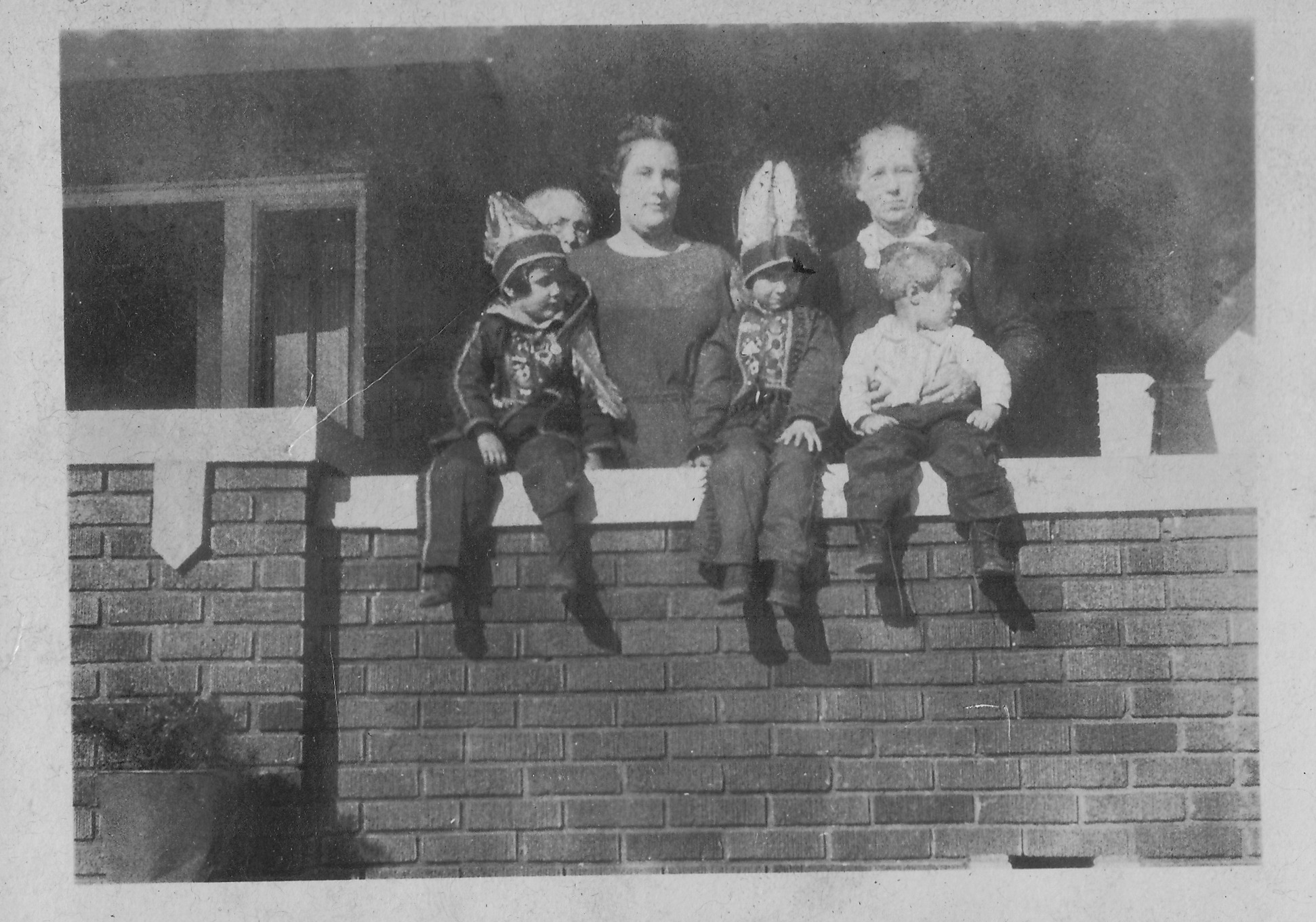
Christmas morning on Strong Avenue, probably 1924; Mamie, Bigma, Jessie, Tiny, Bama and Sara

Merry Christmas to all of you who have been so supportive of Sara’s memoirs this year. She was Christmas for all of us lucky enough to have been in her world, and this is a good day to honor her and her undying enthusiasm for this most sacred of holidays. May you and your loved ones have as much fun on this day as she always did.

Posted in Uncategorized | 2 Comments

Sara Criss’ Civil Rights Memoir #20: Tensions Rising

“An issue of the Greenwood Voice put out by the Greenwood Movement, the group which was leading the marches and voter registration efforts, read:  [Note:Uncorrected original transcript from Greenwood Voice; all errors are those of the author]

On the way from the Court House I, Reverend Tucker and about 50 people (Negroes) that had gone down to register were stopped by 4 police officers, one of them hollered, “lets go, beat it, NOW!!” One of them held a German Police dog on a leash, they started walking toward us, I stood there and one of the policemen said, “this means you” I took for granted that he meant for me to go back because they were coming toward us with the dog. Then the dog ran three feet from me and I said “Man the dog,” he said “beat it,” I was backing up and hollowing to the people to stop running. I had in mind to talk to the officers to ask why, why we were going home that was all. I began backing up until I got to the corner of Howard Street. The officer with the dog kept saying “lets get going” we’re not going to have this. If you don’t want to get bit, keep going. I heard someone say, I don’t know who he is, “get that Black Preacher.” He’s the leader. then the man with the dog gave the dog a little more leach and he snapped my sock, I pulled my leg up and away from the dog and too another couple of steps down Howard Street. Then someone said “Let the dog bite him,” this is when the dog got my leg, the force of it threw me off balance and I fell up against a parked car on Howard Street. I tried to get my leg away from him and dog kept pushing forward and I fell between two parked cars, after this I don’t know what happened to the dog. An officer standing in the street outside the parked car said, “Get up” but I went on out in the street and fell right at his feet, he said, “You’re not hurt n—-r, get up out of the street, you’re not going to lay here.” I tried to move and I said “Oh my leg,” then he said, “Let me see.” I was holding my leg up because it was hurting and he said “It’s just a scratch, there is nothing wrong with you.” Mr. Jordan and a young fellow pick me up. When we got to the corner of Howard and stopped for the red light, the officer said “You had better keep going and find a car or something for him, I can’t keep these people off him any longer, they will kill him.” A truck pulled up with three white men in it, and the one on the outside said “We’re going to put him in the river.” Other voices were hollowing, “Kill him. Kill him. Kill the n—-r.” I didn’t hear anyone say kill him before the dog bit me. They just said, “Get him” “Let the dog bite him.” A cab was stopped and I was taken to Dr. Garner’s office for treatment.’

“The above was the statement the Rev. Tucker had given to the crudely mimeographed issue of Greenwood Voice (voice of the Greenwood Movement). That afternoon, at the request of some of the Citizens Council members, Bobby Pittman, who was Executive Director of the Industrial Board and who was printing the press releases for the City, and I rode out to the Reverend Tucker’s house on Walthall Street to get his side of the story. We were greeted at the front door by his wife. When we asked to speak to Rev. Tucker she answered us, ‘The Reverend is not at home. He has not been home since the tragedy this morning.’ We never did get to talk to Tucker.”
Posted in Uncategorized | Leave a comment

Sara Criss’ Civil Rights Memoir #19: Demonstrators and Dogs

“One of the earliest marches was led by a Negro Methodist preacher, the Reverend D.L. Tucker and a large Negro woman, Ida Holland, who wore tight fitting sweaters and caused one of the Commercial Appeal reporters to refer to her on the front page as ‘bouncy buxom Ida Holland.’ She was known for her feisty manner and the string of cuss words she could hurl at the police and city officials.

“As Reverend Tucker’s group headed toward Howard Street in the downtown area they were approached by Policeman James Switzer with his police dog on a leash. I had left the Court House and walked down to the corner of Howard and Market Streets to observe the march. James Kingsley and Barney Sellers of the Commercial Appeal were still in town to report the news. As the dog moved closer to the marchers the reverend urged the group not to run, and it was obvious he was hoping for some sort of confrontation. They moved on down Howard Street and at one point the dog lunged at the preacher’s ankle. Observers said he was not knocked down but fell to the pavement and was helped up by two of the other marchers.

“Kingsley, who was on the scene, said he did not think his [Tucker’s] ankle was hurt but that his silk sock had a run in it. After the incident the group marched on back to one of the Negro churches without further trouble.

“Mama, who was working at the Red Cross on Howard Street, was able to see the commotion and could not believe it since she, unlike most other folks in town who were not on the street to observe, watched the disturbances first hand. She described it in graphic detail.

“There were various accounts of the incident depending on who was doing the reporting. Claude Sitton, who hung around Greenwood for several months representing the New York Times, filed a story concerning the march. I stood with him while we watched the incident, but his version was a little more dramatic than mine and that of the two Commercial Appeal men. His story which appeared in the Times  read:

Policemen set a snarling dog at the heels of 42 Negroes Thursday as they marched homeward after having applied to register as voters. The German Shepherd lunged again and again at the group and seized the left ankle of the Rev. D.L.Tucker. The minister apparently was not bitten seriously. A half dozen policemen and auxiliary policemen armed with nightsticks drove the other Negroes along a sidewalk in the heart of the business section until they had dispersed. White bystanders yelled at the patrolmen handling the dog, “Turn him loose!” and “Sic ’em, sic ’em.” Mayor Charles E. Sampson was asked why police had dispersed the Negroes, who were marching by two’s along the sidewalk and stopping for traffic signals. “They had a report up there that them n—–rs was going to the Alice Cafe for a sit-in,” the mayor replied. The only arrest made was that of Dick Perez, identified by police as a Columbia Broadcasting System television cameraman. He was released without charges after his film of the incident was confiscated. The dispersal of the Negroes was the latest in a series of incidents accompanying a voter registration campaign in this farming and industrial center in the Mississippi Delta. Racial tension, whipped up by the voting drive and attacks on Negroes, has created an explosive situation. City officials readily concede that they are alarmed. Greenwood’s 30-man  police force was reinforced by 24 auxiliary policemen, sheriffs and deputies from Leflore and surrounding counties, and by state highway patrolmen. Two Justice Department attorneys and six or more agents of the FBI moved into this city on the banks of the Yazoo River. Roughly dressed whites stood on sidewalks in the vicinity of the Courthouse and muttered threats. More than 150 gathered at City Hall Thursday afternoon during the trial of nine of 11 Negroes arrested Wednesday while marching toward the Courthouse to protest against the shotgun attack on a Negro’s house Tuesday night. Six of those tried were found guilty on charges of disorderly conduct.’ [End of New York Times article by Claude Sitton].

Posted in Uncategorized | Leave a comment

Sara Criss’ Civil Rights Memoir #18: The Spin Game

“As I stood watching one of the demonstrations one of the FBI men from Cincinnati, Ohio, told me ‘We are on your side in this thing but are just sent down here to do our job. Where I live we have more segregation than you do.’ When I heard remarks such as his it reinforced my feeling that if we would just treat them a little more kindly they just might go back and tell some of the ‘other side of the story.’

“The news folks were not fooled by what was going on even though they might not agree with the way the blacks had been treated. One of the network reporters told me, ‘We are just as sick of this as you are and realize it is all being staged for us.’ When I asked one of the reporters why they would not stick to the facts concerning the demonstrations, etc., he gave a pretty good answer. ‘When your editor is a thousand miles away and wanting a good story, it is a lot easier to make the story bigger than it is because you know he won’t know the difference.’

Posted in Uncategorized | Leave a comment

Sara Criss’ Civil Rights Memoir #17: Man on the Street

“Many of the newsmen were nice and wanted to be friendly as did some of the FBI but we lived in fear that someone would see us being nice to them. I would have enjoyed inviting some of them to come to our home and showing them that all Southerners were not as we were being portrayed across the country, but I did not dare. With so many of the locals who stood on the street corners cussing the media, I felt that reporters never had a chance to meet with and talk to responsible people who felt just as strongly as they did about the Ku Klux Klan.”

“One day when I was covering the Court House I met Nelson Benton with CBS again in the hall. There were CBS photographers in the Circuit Clerk’s offices filming blacks who were registering to vote. He asked me how I felt about the coverage that was being given to the Civil Rights activities in Mississippi. I told him that what bothered me most was that they seemed to always pick out a fellow in overalls standing on the corner to interview and never talked to our leaders in the community, not referring to politicians but businessmen.

“He replied that the reason they picked the man in overalls was because most of them were willing to talk and the leaders were not. I asked him if I gave him several names of prominent Greenwood citizens who I thought would let him interview them would he do see them, and he indicated he would. However, I don’t think he did.

“Just as I thought I was making a point with Nelson, George Smith, the sheriff, walked up and deliberately asked me, ‘What are they doing in there with those coons?’ and I realized all I had said was in vain. George was a very good law enforcement officer, and I credited him many times with keeping things from getting out of hand, but he knew his remark would shock Nelson and he really wasn’t worried about the impression it left.”

Posted in Uncategorized | Leave a comment

Sara Criss’ Civil Rights Memoir #16: Watching Her World Shift

“Even though it was exciting covering news that was attracting national attention and seeing the top news folks in the country doing their job, it was very draining emotionally because we never knew from one day to the next what might happen to provoke a situation that would bring in Federal troops. Greenwood was so tense, and all of this was so new to us. It was spring time and during that very difficult period the trees on Grand Boulevard turned to green and the azaleas and other flowering shrubs were in bloom, and it was definitely our prettiest time of the year and my favorite time.

“I can remember on my 42nd birthday [April 1, 1963] riding down the Boulevard with tears in my eyes for what was happening to our town, saying a prayer that it would soon all be over and the all these agitators would leave town and let us go back to being the same old Greenwood. We did not know that it would never again be the same and that many heartbreaking times lay ahead for us.”

Posted in Uncategorized | Leave a comment

Sara Criss’ Civil Rights Memoir #15: Voices of Reason

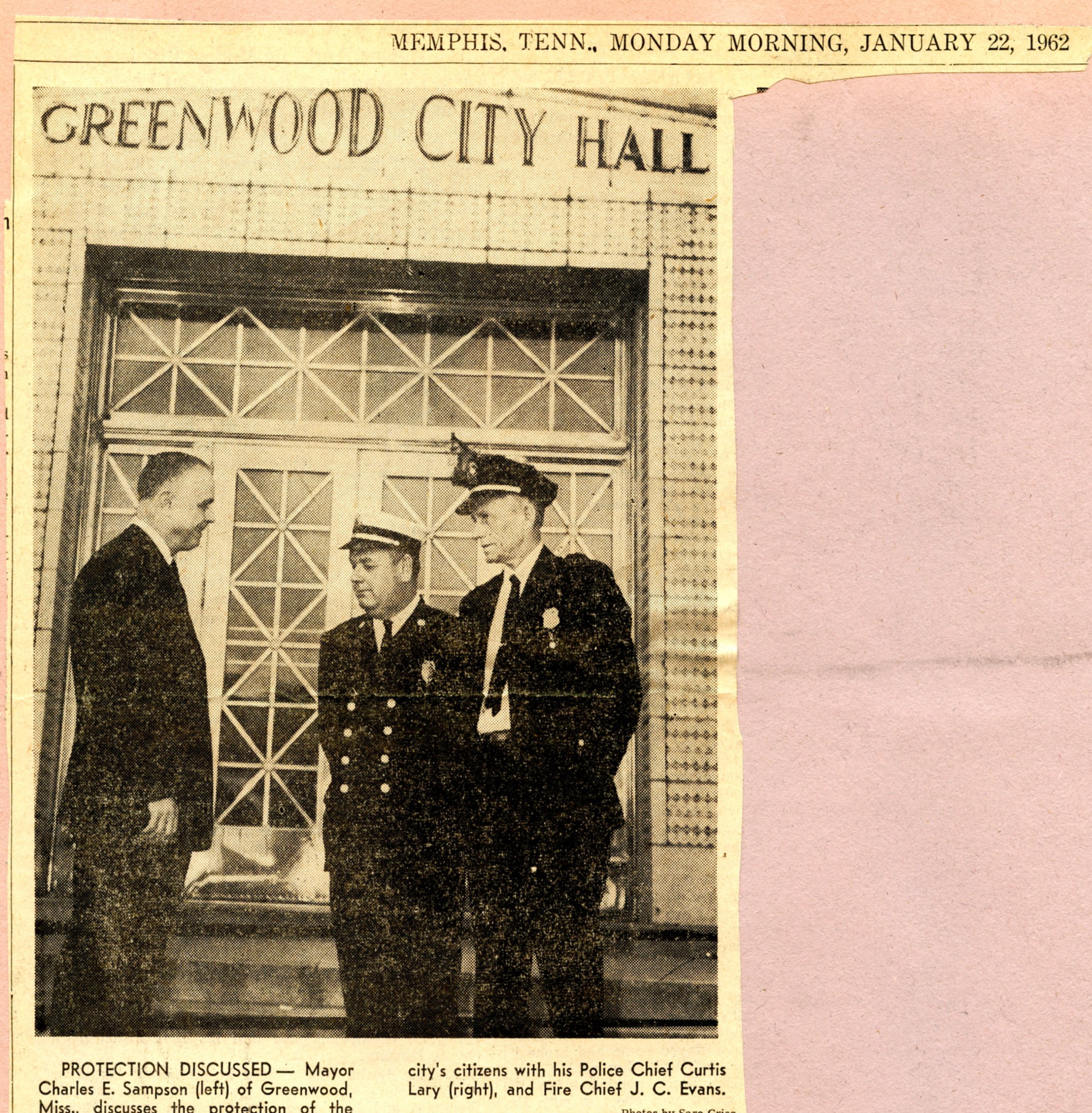
Mayor Charles Sampson, Fire Chief Evans and Police Chief Curtis Lary as photographed by Sara for the Commercial Appeal

“Chief of Police Curtis Lary and his assistant Miller Wyatt were credited with containing the situation and keeping things from getting completely out of hand. Curtis was a frail, quiet man with a gentle nature, and he never let his temper get out of control. He would stand in front of the marchers with his bullhorn and very quietly demand respect. Then if he saw a crowd of whites gathered on the corner he would let them know he did not want any trouble.

“Buff Hammond, the police commissioner, too kept a clear head and often would just laugh when he was thrown insults. A number of local men were on the Auxiliary Police Force and wore hard hats and assisted the police. An old school bus had been painted black and was used to take those arrested to jail.

“Gray [Evans] was city prosecuting attorney during these days and was involved in setting bond and prosecuting those arrested. We kept hearing that his and Tricia’s phone might be bugged, and this kept Mama upset. Gray would be on the phone talking to John Doar, Justice Department attorney, and others in Washington. I am sure Mama would have preferred that neither Gray nor I be involved in all that was going on.

Posted in Uncategorized | 3 Comments

Sara Criss’ Civil Rights Memoirs #14: Young Man on the Rise

“When the Court House marches continued, the Commercial Appeal called Kingsley and Sellers back to Memphis and sent young Larry Speakes, who later was President Reagan’s spokesman and deputy press secretary, to help me. Larry was not long out of Ole Miss and was working for the Greenville bureau of the paper. I feel sure this was his first big assignment, and he came in one morning with his first wife and eighteen-month-old daughter. I did not know what he planned to do with them; certainly he didn’t plan to take them along to observe the demonstrations. So we left them on the back porch all day with Georgia [Edwards, Sara’s maid] feeling sorry for them while Larry and I went to get the story.

“Just as it was time for the Negro high school, Threadgill School, to let out, Larry parked about a block or so away in front of the SNCC headquarters and went inside, leaving me in the car. I was really frightened as large groups of young blacks swarmed down the street, and some gave me dirty glances as they passed the car.

“Later I followed Larry’s career as he worked first for Senator [James O.] Eastland and then for three presidents. He wrote me that many of the White House reporters were the same ones we had stood with on the Court House steps in Greenwood.”

Posted in Uncategorized | Leave a comment

Sara Criss’ Civil Rights Memoirs #13: Foot-in-Mouth Disease

“Mayor Charles Sampson, later our backdoor neighbor and good friend, and the city attorney Hardy Lott were both staunch segregationists and members of the Citizens Council. They loved to issue statements saying that the Federal government had taken law and order out of our hands and forbidding people to gather on the streets and lambasting the Kennedys for all of our problems. Once when NBC invited the mayor to appear on the Today show, he said Hardy and his law partner, Stanny Sanders, had coached him not to say ‘n—-r’ on national television, but then he got on and said, ‘We have lots of good n—-rs who have been voting a long time, such as the janitress at the City Hall,’ referring to my friend Winnie Baskin, who lived to be 100. All the time trials were being held almost daily in City Court, poor Winnie was crouching behind the stairway and asking me what was going on.”

Posted in Uncategorized | Leave a comment