Turkey Sabbatical

“Daughter of the Delta” is cooking (?!) for English friends and relatives this week, so there may be a short interruption in the blogs. And I need some feedback from those of you who have faithfully followed this trip through Sara Criss’ memoirs. I have only a few days’ worth left, as she wrote these in 1990 and never updated them. I do have about fifty pages of Civil Rights Era memoirs which I might post, but they are, for obvious reasons, less uplifting and not altogether complementary of that time or our town. They may have to be heavily redacted, as many people who are mentioned are still alive, or their children still live here. Tell me what you would like for me to do: Leave well enough alone, ending this with Sara’s last memoir entry, or continue into the Civil Rights material. I would very much appreciate your thoughts on this. Happy Thanksgiving to all.

Posted in Uncategorized | 11 Comments

Papa Pickles, Part II

This is not from Sara’s memoir. Just a personal observation, so bear with me.

LSU 52, Ole Miss 3.

My father taught me to love many things in life, not the least of which was Ole Miss football. And he taught me to hate almost nothing, except the New York Yankees and LSU. I miss him most during football season, but on nights like this, I hope there’s no transistor radios and no ESPN in heaven.

Posted in Uncategorized | 2 Comments

Papa Pickles

Russell being the good sport for some Heinz promotion.

“In 1979 Russell’s thirty-three year job with H.J.Heinz Company came to an end, when they terminated all of the sales force and decided to sell their products through food brokers. It was quite a blow because he had intended to work for them until he had to retire and he was only 62 at the time. At least though he was eligible for retirement and also received pretty good severance pay based on the number of years he had worked. Fortunately he immediately got a job with Fulcher Evans and Welsh Food Brokers, who had gotten the Heinz line and started to work for them right away and continued to work for them until October, 1987, when they terminated his job after being bought out.

Russell and Tricia with the girls, probably 1956

“We did get a nice trip to Hawaii to the Lewis Grocer Company convention just as his job with Heinz ended. We had gotten some nice paid trips to Las Vegas, Acapulco, New Orleans and the Mississippi Gulf Coast through his Heinz job.

“Heinz was a big part of our life for those thirty-three years, and Russell worked hard at his job as a salesman. For years Cathy and Mary Carol thought it would be a sin to eat Campbell’s soup or Gerber’s baby food. It took everything he made for us to live while they were growing up, and if we had not budgeted our money carefully we probably would not have done as well as we did. Every two weeks when his Heinz check came in, we doled it out to the various envelopes we had set up and which we called ‘the pouches.’ Of course, we would borrow from one pouch to help out another occasionally, but we always paid our bills at the end of the month and bought very few items on credit. It was always Russell’s firm conviction that ‘if you can’t pay for it, don’t buy it but wait until you have the money to do so.’ I remember one time when the air conditioner, the refrigerator and the washing machine all went on the blink at the same time, and I sat down and cried because I didn’t see how we could pay to have them all fixed, but we made it.

Man of the house

“He was offered transfers which would have probably meant promotions, but money was never our primary concern. We both wanted roots and wanted our children to have roots. After moving from town to town during the Depression, Russell was especially anxious for his children to grow up in one town, and when we moved into our house he made the remark, ‘I want to die right here in this house.’

You’re not going to get much from me on Russell, as I simply can’t do it, even after he’s been gone for almost 20 years. Suffice it to say that this man, who barely knew his own mother and who watched his father struggle just to put a roof over the heads of his family through the Depression and who was dragged through ten different high schools, was so grounded and so determined to raise his girls with stability and those roots that Sara mentioned that he passed up all hopes of promotion, more money and more prestige to stay right there on East Adams. He made Greenwood his home and loved each and every Evans as if they were his own blood. It could not have been inspiring to head out each day across the Delta to stock baby food and pickles and ketchup and soup, but he did it because it had to be done and he did it well. I cherish the memory of all those nights when he would finish his sales report, seal it up and say, “C’mon, Charlie, time to make our rounds.” We’d stop by the Greenwood Leflore Hotel to weigh the mail (and visit with the desk manager) and then head over to the old Post Office, where it was my great privilege to slide the Heinz envelopes through the brass slot and open the lock on Box 506 for the night’s mail. Then, if it was a really good night, we’d go by Chaney’s Drugs for a comic book and on to the Russell Company, where I’d ride the conveyor belt while Russell checked his inventory. There was one night when a salesman I had never met looked at Russell, looked at me and then just fell out laughing. “Criss, you really marked that one!” I badgered him all the way home as to what in the world that odd man could have meant, and he just shook his head and smiled. He knew I was marked for life in more ways than that.

We always had a pantry stocked floor to ceiling with tiny jars of applesauce and bottles of ketchup and mustard and cases of soup. It’s amazing what a creative cook can do with nothing to work with but Heinz products. And the title of this blog? When the CB radio craze hit in the mid-70s, Russell found a new calling in talking with the truckers as he drove the highways and back roads. Cathy’s best friend, the inimitable Kathy Koury Keyes Knudsen (she deserves her own blog, another day), gave Russell the “handle,” Papa Pickles. He was so proud of that.
Posted in Uncategorized | 2 Comments

Mamie and Howard

Howard, Gray and B.J.

“Mary and Howard had moved back to Greenwood from Ohio in 1980, and in September, 1981, Howard died. Mary and I had been out to the hospital and to the nursing home, and he was going to go hunting with B.J. [Tiny’s husband], Son and some of the other men in the family. When she got home she found him in his chair. He had apparently died shortly after we left the house. We all loved Howard and had looked forward to having Mary and him back in Greenwood. He was enjoying hunting and fishing and had just bought a new boat the day before.”

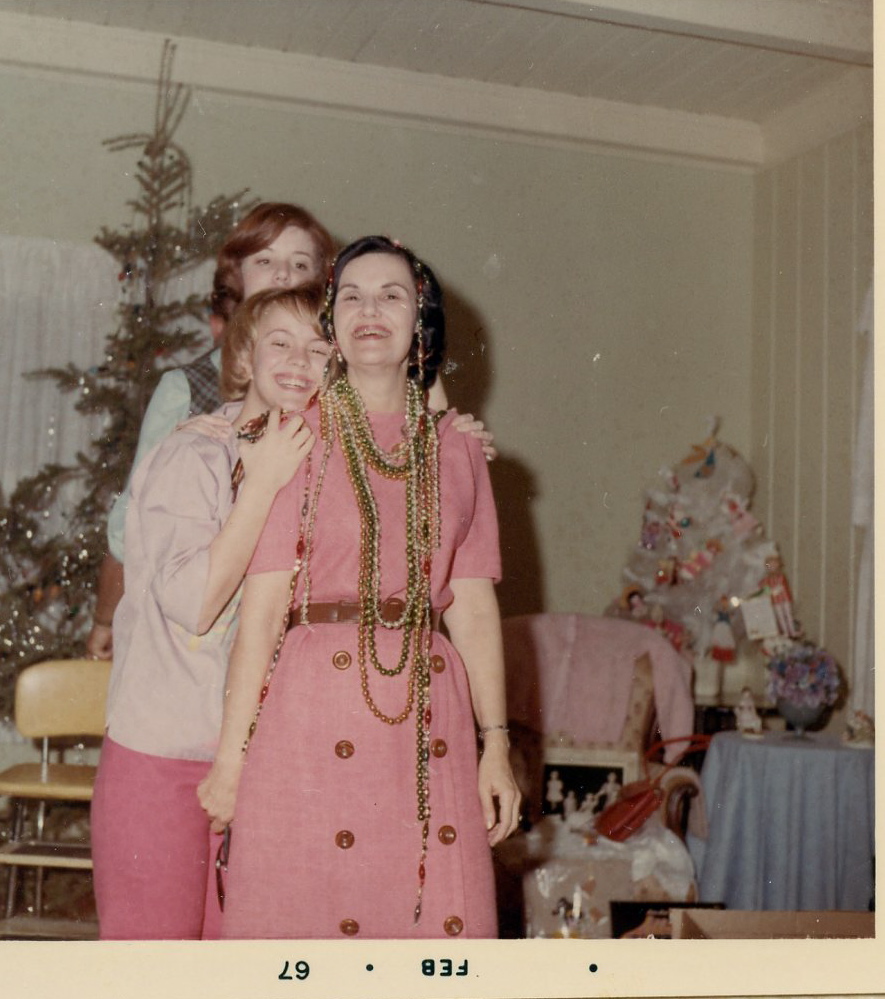
Melanie, Cathy and Mamie, Christmas circa 1966

Mamie and Howard and Melanie, our exotic Ohio relations. Who were secretly always a Greenwood girl and an Itta Bena boy, but who took big trips and met famous people and lived around the corner from Jack Nicklaus (or was it Arnold Palmer? I forget.) and Dave Thomas of Wendy’s fame. Who swept in twice a year, summer and Christmas, in a Cadillac bigger and fancier than anything we ever saw in this podunk town, loaded down with gifts and stick donuts and Schnauzers and tales of the wide world outside Mississippi. The buildup to their arrival was almost unbearable, as was the annual trip to the depot to pick up the Christmas presents which Mamie was famous for. She would spend weeks handcrafting individual creations to go on each package, personalized for the recipient, and they were so wonderful that Sara would collect them and hang them on the next year’s tree. Mamie was all giggles and teasing and silliness, but underneath that facade was a deeply talented and thoughtful woman, the aunt you all wanted and never got. Well, I did, and I got Howard as part of the bargain. Howard was a gentle giant, a great bear of a man who would sweep you up onto his shoulders and parade you around until you just got too big to have that done. He would load all the little Mississippi cousins in his convertible and ride us back and forth across the Keesler Bridge, turning the radio way up and singing Christmas carols while we got dizzy looking up at the passing girders. Other than Russell, he was probably the sweetest man I ever knew, and it was such a blow to this whole family when he left us so quickly and unexpectedly.

Mamie and Sara were only fifteen months or so apart in age and they could butt heads like two billy goats over absolutely nothing. But when it came time for the Cadillac to be loaded up for the long trip back to Ohio, Sara would disappear for awhile, into her own world, giving up her childhood buddy once again. She enjoyed the years when Mamie was back in Greenwood, before Alzheimer’s crept up on her and took away our sweet, laughing aunt.

Mamie and Jessie, yet another Christmas Eve

Posted in Uncategorized | Leave a comment

Matriarch

Jessie at one of Sara's Christmas Eve parties

“In 1981 we put Mama in the nursing home. She did not want to go but for a while enjoyed the company and being waited on. In the last year of her life she could not remember things very well and was terribly frustrated. She knew that Mary Carol was going to have a baby but she did not live to see Emily. In 1983 she had heart failure and died in September after being in the hospital three weeks in more or less of a coma. It was then that I realized what an important part of my life she had been and how much she had meant to her grandchildren and the great grandchildren who were born before she died.”

Mamie and Tricia look on as Jessie has a word with Santa Claus, Christmas Eve.

I’ve said so much in these blogs about Jessie that I simply don’t know what else to add. She was so central in my life and the lives of all her children and grandchildren and there has been such a hole in our universe since she left us 28 years ago. I knew her as a sweet, warm, loving soul growing up, but I had no clue what kind of tragedy had befallen her as a young mother. She never mentioned it. She never engaged in recrimination or self-pity or remorse. She had accepted the Stotts’ offer of a home for her family, stayed there 28 years, raised her children in that house with an awareness of the gratitude owed to their aunt and uncle and cousins and made a life for herself beyond the bounds of marriage and early widowhood. She mixed drinks for the Air Base cadets and brought soldiers home for family crises through the Red Cross and provided a center, a solid base, for our extended family in her duplex on West Claiborne. Her long green couch could hold most of her offspring and the toy box in the corner by the TV was stuffed full of blocks and trucks and dolls and balls and everything a grandchild could need. After she retired from the Red Cross, she rarely left the house other than for runs to the grocery store with Tiny, but she dressed up and made a grand appearance each year at Sara and Russell’s big Christmas Eve party. What must she have thought on some of those nights, seated in her big comfortable chair, looking at the overabundance of presents spilling out from under a huge tree, just waiting for her five children and eight grandchildren to start opening them? Those children were all successful and married to wonderful Evans-in-laws and the grandchildren were healthy and happy if not always on their best behavior. Occasionally, though she never mentioned it, her mind must have drifted back to quieter, leaner Christmases in Durant and loved ones long gone and to that long drive home from Jackson in 1932, facing a Depression Christmas and a future with five children to raise alone. Her favorite saying, when one of us would climb up in her bed and pour our troubles out to her, was “It’s always darkest before the dawn.” She said it with conviction, for she had lived it.

A few years ago, I sat for a photographer in Tupelo to have some promotional portraits made when one of my books was coming out. The proofs came back online and when I opened the website, I just had to laugh. There was Jessie, looking out at me from my computer screen.  As my own face ages and changes, I can see her in my own mirror, and watching each of her children, Tiny and Mamie and Sara and Son and Tricia, age has demonstrated a similar transformation, sometimes in an almost startling fashion. She’s been gone for more than a quarter-century but, as with all good mothers, she lives on in those she loved and molded.

Jessie and Sara, about 1923

Posted in Uncategorized | 2 Comments

The Saints Go Marching Out

Roy and Olive West Stott ("Big and Uncle Roy"), 50th Wedding Anniversary

“In 1970 Uncle Roy died and five years later Big. They had been so good to all of us and it was hard to imagine that they wouldn’t always be around. Big had moved to the nursing home and spent her last years there. She was one of the few people I have known who made up her own mind that it was time to go there, and she made the best of the situation.”

Roy Stott's retirement party, late 1950s. Big and Uncle Roy are at the far right; Sara is in the foreground, back to camera (for once).

This pair in my child’s mind was like one person and one long name: biganduncaroy. Inseparable and precious and of another era. My grandmother, Jessie, lived in their house until I was 6 years old, and it did not seem the least bit strange that she cohabitated with her sister and brother-in-law nor that my mother had grown up in her uncle’s home. That’s just the way it was, and some of my earliest memories are of 115 East Washington and the Stotts. You’ve read in these blogs of how kind and sacrificing they were, taking in Jessie, five children and a grandmother quite unexpectedly in 1932. They remained just that way, thoughtful and quiet and just going about their own business. Uncle Roy was stalwart and strong and as rock steady as any human being I have ever known, a gentleman of the highest order. In my memories, he is sitting in his big overstuffed chair, reading or watching TV, or walking down to the old Greenwood Leflore Public Library for a grocery sack of Westerns or mysteries. He would walk me and my cousin, Jay, downtown, stopping in at the Utility Plant or the police station, and I well remember him taking us back to the jail and telling us if we didn’t behave that we would wind up behind bars. We took note. As the “new bridge” over the Yazoo was being built, you would often find Uncle Roy standing there on the bank, watching and observing and probably so much more capable than those actually doing the work. He came to Greenwood from backwoods Tennessee with barely a junior high education, way back in the earliest years of the century, and went from climbing light poles to running Greenwood Utilities for 50+ years.

Big could come across as stern and humorless, but that impression was way off the mark. She had a great, quirky sense of humor, just like Jessie and she would go the extra mile to help anyone in need. I remember many trips down the slippery Yazoo banks at the end of Walthall with her, carrying clothes or extra food to the family who lived in a shanty atop pontoons down there. She had a reputation as the best private nurse in town and was privy to all the gossip from those nights spent at someone’s bedside. I’m so grateful that she had the courage to leave her Holmes County base in 1908 or so and come to the “big city,” Greenwood, to pursue a nursing career. Because Jessie followed her a few years later and the rest is history. Our history, the story of Jessie and Howard and their children and grandchildren, all entertwined with the Stotts on East Washington. This quiet, strong couple saved my mother and her family, beyond any doubt, and I’m so glad they were part of my life until I was grown.

Big and Uncle Roy, young and happy.

Posted in Uncategorized | 1 Comment

Wishes and Weddings

“There have been many exciting times in my life, but two of the most exciting were the weddings of Cathy and Mary Carol. They were a lot of work, but I enjoyed every minute of it. It was fun making all the refreshments, seeing all the beautiful girls, making Cathy’s wedding dress as well as the bridesmaid’s dresses for Mary Carol and Beth [Roberson], and all the other exciting things that went on. When Mary Carol was accepted for medical school and when Cathy got a job with Southern Living magazine we felt that all our highest hopes for them were falling into place. We have not measured our success in life in terms of money but in having such wonderful children and grandchildren.”

I know much of Sara’s memoirs were written with her rose-colored glassed perched firmly on her nose. That’s the prerogative of the autobiographer and it often makes for a more interesting narrative. But I have to draw the line of blind acceptance at her statement that “the weddings…..were a lot work, but I enjoyed every minute of it.” Mine and Cathy’s weddings were like the famous Evans family Christmas Eve Party on steroids. Those December 24th parties (which we will eventually cover in a blog, don’t worry) were high octane, labor intensive celebrations that we all loved, but every year I feared for the stability of my parents’ marriage and wondered which of them was going after the other with a turkey carving knife first.

So, the weddings. Sara may have “enjoyed every minute” of the runup to those joyous occasions, but she had a funny way of showing it. Cathy and Tom Adams announced their engagement in the fall of 1972, planning for a January 1973 wedding. Sara hurtled into overdrive: Planning each detail, cooking all the reception foods, making the wedding dress (think about that pressure, folks) and two bridesmaid dresses, dealing with the First Presbyterian Church hierarchy, practically moving in with Coleman Craig for flower discussions, etc. etc. etc. I don’t remember coming home from college at all that fall and Russell came down to Jackson at every opportunity, ostensibly to go to Ole Miss games with me but more likely to escape the escalating tension at 409 East Adams. By Christmas, the train was rocking along the rails at a frightening clip and we were all scrambling for cover.

Sara and Russell knew that January weddings were a dodgy bet. Their own had been a soggy challenge up in Minter City, but Cathy’s Saturday dawned winter bleak but dry. A couple of days before, with each and every detail seemingly covered,  all of Sara’s careful plans hit an unanticipated and uncontrollable bump: A prominent local citizen committed suicide and his funeral was planned for a downtown church at the same time as the wedding. Sara took this as a personal affront and went ballistic, venting her wrath (not publicly, of course) on all members of that tragedy-stricken family, their denomination and the sheer insensitivity of a man who would exit this life without consulting the social calendar. I don’t know if Valium was available in the early ’70s, but we could have used a large bottle of it.

Cathy’s wedding went off without a hitch. My fondest memory of that day involves a confluence of weather and history. The Vietnam Peace Treaty had just been signed and President Nixon decreed that at 11am on January 27th (the time and date of the wedding), all the church bells in America were to ring. The day had started out very overcast and dull, but just as Cathy started down the aisle on Russell’s arm, the sun broke through the clouds, flooding the Presbyterian Church with sunshine. Almost simultaneously, the bells of the Episcopal, Methodist, Baptist and every other church in town began to peal, along with the courthouse chimes, almost as if the whole town and heaven itself were putting their imprint of approval on what was occurring there on Main Street. It was a magical moment and one that even Sara couldn’t have orchestrated.

Ed. note: There are no pictures here because that was the Worst Bad Hair Day anyone ever had for me. And it’s my blog, so I rule. No pictures.

Posted in Uncategorized | Leave a comment

Real Retirement

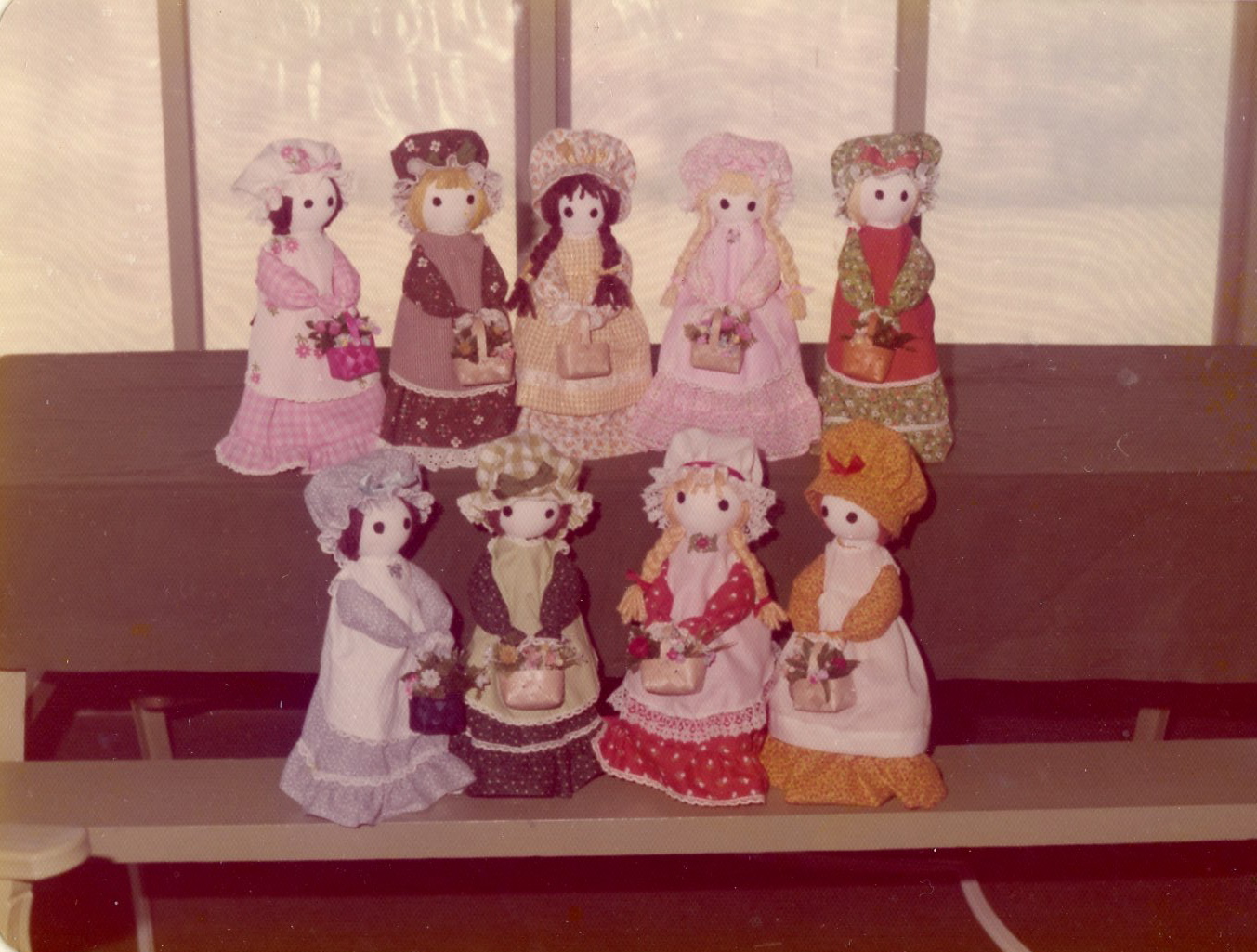
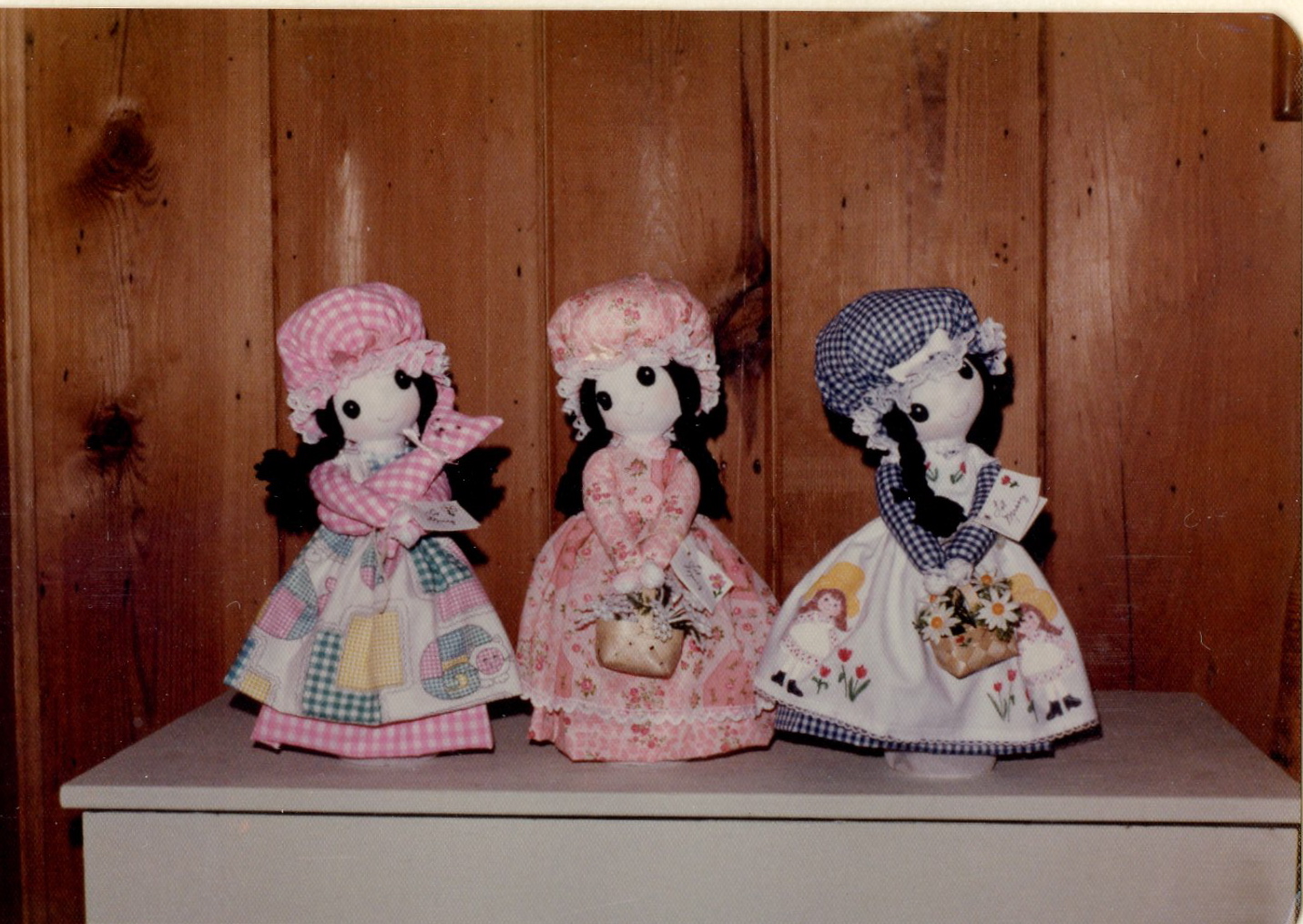
“People were so nice to save their throw-away Coke bottles for me and Russell would check all the discount stores and dime stores on his territory looking for the type of nylon sock we used and for styrofoam balls at the best price. We found lace trimming cheap at a place in Grenada and bought it by the pound. This way we kept the investment in each doll very low. I would make them assembly line fashion, glueing the balls on the bottles twenty or more at a time, then making their faces and putting their yarn hair on, and then dressing them. No two looked exactly alike, and this was one of their attributes. People felt like they had bought a one-of-a-kind item.

“We met a lot of nice people at the arts and crafts shows and became friends with many of them and swapped our crafts. The last show we signed up for was the fall Canton Flea Market, which was always our biggest and best show. This was in October, 1982. I had made over one hundred dolls and dozens of little stuffed dolls for Christmas tree ornaments, as well as stuffed pumpkins and trick-or-treat bags and other items, and the living room was crammed full of tables holding all the things I planned to take. We were to go on Thursday and on Sunday Russell went to the hospital for tests because he was having trouble swallowing his food. On Tuesday we learned that he had an [abdominal] aneurysm and would have to go to Jackson for surgery.

“I was so upset when I came home from the hospital that night that I stayed up until past 12 o’clock taking all the things back upstairs. Later I sold most of them from home but that ended our trips to the shows. By this time I think we had had about enough of it anyway. It was a very interesting experience though, and I got a lot of satisfaction out of knowing that I could create something that many people were willing to buy, and the looks of the faces of hundreds of little girls as they reached for those dolls and the smiles on the faces of people of all ages when they saw my girls all rowed out made it all worthwhile.”

From the perspective of age and time, I don’t know why I didn’t jump in and make that last Canton Flea Market trip happen. I guess I was young and cocky and busy and just didn’t realize how crushed Sara was at this disappointment. What I do recall quite clearly is how frightened she and Russell were. He had had a few health scares over the years, as those who smoke 3 packs of Salems a day for 40+ years might expect, but this was a bombshell. He was walking around with a football-sized balloon pooching off his aorta, just waiting to rupture. When he called me at work in Yazoo City, I could hear the fear in his voice and he was fighting back tears. You grow up very quickly when you realize that your father can be scared and can cry and, God forbid, can die. The dolls just didn’t seem very important in the great scheme of things at that point.

Russell was a trial for his doctors. They were pushing everything they had into his lungs, valiantly trying to shape him up enough to go in and take care of that aneurysm, while he lit one cigarette after another. It’s a wonder he didn’t blow Baptist Hospital right off of North State Street. Finally, his altogether exasperated cardiologist came in, wrinkled his nose at the pall of tobacco smoke hanging in the air and declared, “I’m sorry, Mr. Criss, but you’re going to die. I can’t help you.” Russell put that last half-pack of Salems on the nightstand and never touched another one again. He still had that stale cigarette pack, with all 11 cigarettes inside, when he died ten years later. Way to go, Daddy.

Posted in Uncategorized | Leave a comment

Doll Daze

“Then we would go to the Canton Flea Market and come home with nearly $1000, and we would be ecstatic. I would head back to the sewing machine to turn out dozens more of them. The first doll I had seen in the magazine had on a Betsy Ross outfit in honor of the upcoming Bicentennial celebration. I made a number of Betsys that year and they sold very well.

“Most of what I sold though was dolls to go in little girls’ rooms. I bought little flowered prints and checked gingham everywhere I could find them at a good price and matched them up in blues, greens, pinks, yellows, peaches, etc. They had blonde, brunette and red hair and sometimes it would take customers a long time trying to pick out just the right one for a little girl. Some went to grownups too and to people in nursing homes. I sold them to all ages from two years old up to those in their nineties. It was evident that little girls never outgrow their love of dolls.

“I also sold brides, black mammies, Mrs. Santa and angels. The Christmas dolls sold like crazy every fall. I took the original idea for the doll on the bottle and changed it up and shaped the styrofoam heads and made their faces cuter and their dresses and pinafores prettier so that the ‘Lil’ Missy’ dolls, which was the name I gave them, were really my own original creations. I had lots of little old ladies trying their best to copy them, but I never did see any who were quite successful, and I was very careful not to ever share my pattern.”

Sara and Russell worked as they had never worked before once the doll phenomenon really took off. As much fun as it was for Sara, buying material (always a passion) and crafting tiny dresses and pinafores and bonnets, it required hours of packing and sorting and hauling and setting up tables at crafts shows. When she had a slow day, she would be down in the dumps, but invariably decided that that particular town was “just country,” i.e., full of bumpkins who didn’t know quality when they saw it. I will not name names here, but there were certain communities which she never forgave. Including Tupelo, where I lived for 12 years, because she was never invited to participate in the Gum Tree Arts Show. She felt that those folks were just way too big for their britches, and she was probably right. I never saw anything on the Lee County Courthouse lawn nearly as cute as her dolls. Tupelo’s loss, for sure.

Russell was in his glory during the doll days, as he got to cruise the crowds and drum up business, and the natural-born salesman in him would go into overdrive. I’m sure he was appreciative of the money coming in, but he was most pleased at how excited Sara would be each and every time a little girl walked away clutching a doll. There’s never been a mutual admiration society like the one those two enjoyed for fifty years and this era was the culmination of believing in each other and supporting each other through thick and thin.

The Team

Posted in Uncategorized | 1 Comment

Dolls by the Dozens

“We probably sold at least 3000 dolls, keeping our price at $10 until the last year, when we went up to $12. They were selling faster than ever when we quit the business. We sold some to people who owned gift shops and some people bought as many as ten or twelve for gifts. The dolls went to England, Canada, Germany and to many of the states of this country. I gave a lot of them away as teacher presents for Jeff [Cathy’s son], as graduation and birthday presents, and to friends. Often when a little girl would hang around my table and beg for one if her mother wouldn’t buy her one, I would end up giving her one, and I made lots of little friends that way. I knew what it was like to see a doll you wanted so bad it hurt.

“Russell and I both probably worked harder at this job than any we ever had. We would fill up the living room with dolls on tables for weeks before the shows, and then on Friday we would pack them in Coke boxes and fill the car with as many as would squeeze in (sometimes there was hardly room for us in the car). We would leave home as early as five in the morning to get to a show early enough to get a good spot and set up our display. We fought the heat, the wind, and the rain and cold and often had to drop cloths over them to keep them from being ruined by the elements.

“During one show in the little town of Hernando, we were showing our dolls on the Court House square. Shortly after noon I had sold only four dolls so was pretty discouraged and had wandered off to look at the other exhibits and talk to the exhibitors. Russell was tending the dolls when suddenly there was one clap of thunder and here came the rain and hail. The Shrine Band from Memphis had just started to play on the Court House steps when the bottom dropped out. Two kind ladies came to Russell’s assistance and helped him try to hold the drop cloth over the dolls with the wind blowing fiercely. By the time the storm ended we were drenched and cold. A few of the dolls were ruined. I thanked the ladies for helping to save the others and one of them said, ‘Well, we were just so sorry for your Daddy.’ Russell said that statement puffed me up so much that I didn’t care how many babies I had lost.

“He sent me across the street to Fred’s Dollar Store to buy him a dry tee shirt and bedroom shoes for both us since our shoes were soaked. The only ones I could find for myself were some slides in red, white and blue and covered with stars for the Bicentennial which was being celebrated the next years.We stopped in Sardis on our way home to get a cup of coffee and got some strange looks when we walked into the restaurant, still wet and in bedroom shoes. It was days like that when we had to reassure ourselves that this project was really worthwhile.”

It was worthwhile. Both financially and mentally, as Sara and Russell headed into their retirement years. I never knew where they were on any given weekend during those doll-making times, but I believe the effort kept them young. I do recall going out to the Mississippi College campus in the spring of 1978, where Sara was selling dolls as fast as she could put them out. Jimmy and I sat down with her and Russell, chatted awhile, and then I asked them if they were available the first weekend of May, 1979. Sara gave me a funny look and said, “I don’t know. That’s a busy time for crafts shows. Why do you ask?” I took a deep breath and said, “We were thinking of getting married that weekend.” Total silence. Sara hesitated a minute and then replied, “Well, if it doesn’t interfere with a show, that will be fine.” Never one to get her priorities out of order.

P.S. We got married May 5, 1979. Sara worked us into her schedule, but we had to work around the dolls to display our wedding presents.

Posted in Uncategorized | 1 Comment