Sara Criss’ Civil Rights Memoir #71: Fools on Parade

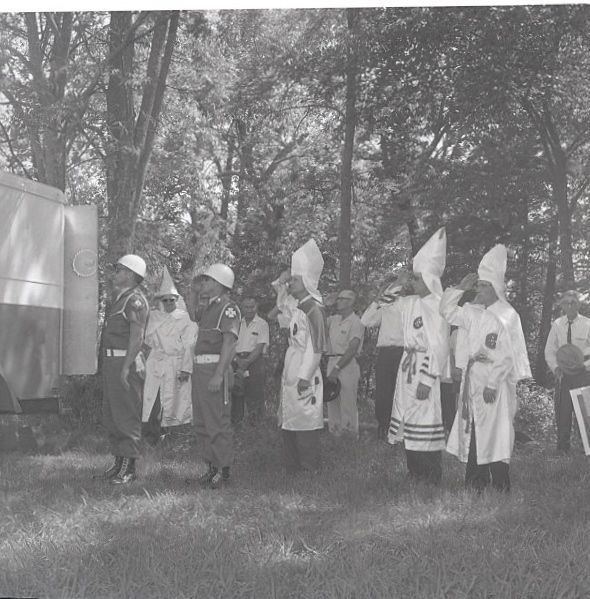
One of Sara's photos, probably from the 1966 Klan rally

“In May of 1966, on a hot Sunday afternoon, we attended a Ku Klux Klan rally on the grounds of the Veterans of Foreign Wars Clubhouse. Russell, Carol Franklin of the Commonwealth and I drove out to the site where a large sign was posted close to Highway 82 East advertising the rally. Members of the Klan Security Guard were posted at the entrance to direct traffic. We were a little afraid of what we were getting into but drove on in. About 200 persons attended the rally and listed to fiery speeches by the Grand Dragons of the United Klans of Mississippi and Louisiana.

“Many of those attending wore the white robes. ‘Dixie’ and ‘The Star Spangled Banner’ were being played on record players. De La Beckwith was introduced to the crowd and walked to the platform amid loud applause from the gathering. ‘The Ku Klux Klan is coming back from every hill and hollow,’ shouted E. L. McDaniel, Mississippi Grand Dragon. ‘It is the only thing left,’ he added. They referred to Martin Luther King as a ‘dirty rotten filthy skunk n—-r.’

De La Beckwith at the same rally

“The FBI, the Justice Department, Greenville newspaper publisher Hodding Carter and ministers came under attack as well as Senator James Eastland, Governor Paul Johnson, along with the president. The meeting ended with the burning of a large cross as robed Klansmen and Klanswomen, carrying small burning crosses, circled a large one. Most of the Klansmen in robes were from other areas. At least three arrived in a car bearing Lafayette County (Oxford) tags. I took pictures with no interference, but we were all three just as glad to get away from there with nothing being said to us.

“Some of the members of the VFW were furious when they learned that the Klan had been given permission to meet on the grounds. An ad in the newspaper had announced that the rally would be held two miles east of Greenwood on Highway 82 but did not state that it would be held on the VFW grounds. A few days later Deloach Cope, state commander of the VFW, issued a statement that the National Headquarters of VFW had suspended the charter of the local group for the time being until the matter could be cleared up. No one wanted to admit they had given them permission to meet there.”
Posted in Uncategorized | 2 Comments

Sara Criss’ Civil Rights Memoir #70: Sovereignty and Singers

“Many of those who had taken part in the activities in Greenwood were active in the MFDP (Mississippi Freedom Democratic Party) and in newspaper reports which have included some of the activities of the Sovereignty Commission during the ’60s it was stated that the Commission planted spied in the MFDP to gather information that would keep black candidates from winning political office in the 1960s. The article stated : ‘The spies compiled rosters of the party’s supporters, obtained records of its meetings, and wrote elaborate reports about its candidates’ strategies.‘ These revelations came from the personal papers of Governor Paul B. Johnson, Jr.

“The MFDP operated from 1964 until 1968 to provide alternative black candidates to the white-controlled regular party that had dominated state politics, according to the article in the Clarion-Ledger. The Freedom Democratic Party held a meeting at the black Masonic Temple in Jackson to pick their candidates and held a convention three weeks later. Then they held a mock election to see how many black people would vote.

“One weekend word got out that there would be an integrated ‘Hootnanny’ with well-known folk singers appearing. It was to be held on Laura McGhee’s property. Laura was the mother of our best-known civil rights activists, Jake and Silas. She lived on Highway 82 East about halfway between the VFW Club on one side and the Moose Lodge on the other. Russell and I went out on a Saturday afternoon to check it out. They had announced that the Kingston Trio, Joan Baez and others would be there. We stayed across the highway with the highway patrolmen, sheriff’s deputies and others and watched and listened.

“None of the better-known performers appeared, but there was loud music, freedom songs and speeches. The location was only a few miles from the Carroll County line, and we felt like Carroll County had some pretty strong Kluxers. Also the Moose Lodge and the VFW livened up on Saturday night. It lasted until almost dark, and we were pretty apprehensive when we thought it might continue after dark. Luckily, it broke up with no incidents.”

Posted in Uncategorized | Leave a comment

Sara Criss’ Civil Rights Memoir #69: The League

“The Negro Voters’ League, led by a school teacher, David Jordan, as much a racist as De La, became more and more active after the blacks started voting in large numbers, and white candidates soon realized they would have to have some support from the black community to win in many instances. They began going to the Voters League to speak and solicit their votes. Before each election the League would endorse those they wanted elected and pass out sample ballots in the black neighborhoods. Since many did not know who they were voting for, they just checked the names of those on the sample ballot.

“I went to one meeting of the Voters League when Gray was running for Circuit Court Judge the first time. Harry Merritt, who was at the Commonwealth, went with me. I could not believe how they treated the candidates. Charles Sullivan, who was running for Governor, and Gray were the only two on the program and when they were not speaking they were made to go in a back room and sit. They asked pointed questions to try to embarrass them. They had apparently already made up their minds to support Gray’s opponent, Webb Franklin, who is Hardy Lott’s son-in-law. After the meeting I told Alex Sanders, now a black supervisor [1990], that I could not believe they would support him with Hardy being known as probably the strongest segregationist in Greenwood. He replied, ‘It’s still open.’ In other words, money could talk. The blacks soon learned they could demand money from the candidates to pay for votes, and this was believed to be a widespread practice. All of these things have discouraged good people from running for public office, and in 1990 everyone is worried about the future of Greenwood.”

Posted in Uncategorized | Leave a comment

Sara Criss’ Civil Rights Memoir #68: Unforeseen Consequences

“One of the complications which arose from the addition of thousands of illiterates to the voting rolls was the time required to select a competent jury. Many who were called for jury duty had to be excused because they could not read or write. Others who claimed they could admitted that their ability to understand what they have read was limited. At one trial a juror was asked to read a short item from a newspaper about the election of a state legislator. When asked to interpret what she had read, she answered ‘It means when you serve on a jury you don’t discuss it with nobody.’

“At the time the Voting Rights Act was passed, a person had to be 21 to vote. Later when this was amended to 18, problems arose in local county elections because it was ruled that college students could vote in the locality where they were attending school, regardless of where their home was. Students were brought in from Mississippi Valley, a black college at Itta Bena, by the busload to register and vote. Thus they could control the vote in the district in which the college was located. Students from as far away as Illinois and California were voting in local elections.”

Posted in Uncategorized | Leave a comment

Sara Criss’ Civil Rights Memoir #67: An Imperfect System

“When the first election was held after all the new voters had been added, the Justice Department attorney John Doar set up an office for several days in Greenwood to direct federal observers who had been sent here to watch the polling places. He told me ‘We are here to help local officials as well as voters to make elections easier with all the new voters added to the rolls.’ He said the observers were not to interfere but just observe and than any complaints would be reported back to the Justice Department. He said they were Civil Service employees.

“They listed every person voting and made an attempt to determine how many were illiterate. At 11 a.m. one poll watcher said 80 percent of the women and 25 percent of the men at one polling place were illiterate. Voting officials had a real problem deciding what to do with one elderly Negro man who proved not only to be illiterate but also deaf and mute. ‘There was just no way to communicate with him,’ said an official. They called in a Justice Department attorney to give a suggestion. He agreed that the man would have to be sent home without voting unless he could bring an interpreter. One Negro woman, obviously voting for the first time, was being assisted by a local voting official. She was told, ‘You are voting for Senator. Which one do you want to vote for?’ ‘Oh, I don’t know,’ she replied. ‘I don’t guess it makes no difference.’

“Local election officials assisted illiterates in the voting booths but had trouble keeping the new voters from conferring with one another while marking their ballots. More than a dozen examiners set up headquarters in the Post Office after the election to hear any complaints which were reported to the Justice Department.”

Posted in Uncategorized | Leave a comment

Sara Criss’ Civil Rights Memoir #66: Voting Rights

“On August 6, 1965, President Lyndon Johnson signed into law the Voting Rights Act. We did  not fully realize how much this would affect our city and county and state in the years to come. After the Voting Rights Act was passed the Justice Deparment announced they were sending Federal registrars to see to it that everyone who wanted to register to vote was registered. The poll tax ($2) which had been charged anyone registering was abolished and no longer could the Circuit Clerk give a test as a requirement for voting. There were to be no literacy requirements, even though under the new law some states were allowed to have literacy requirements. Since Mississippi, as well as some other states, had ‘systematically denied blacks the right to vote’ we were treated differently.

“Soon after the bill was passed the registrars arrived in the basement of the old Post Office. We were on the coast at a Lewis [Grocery Company] Convention when we heard that Greenwood and Canton were the first two towns in the state where they would be sent. When we got home and drove by the Post Office, there were long lines on the sidewalks waiting to be registered. You could hardly get into the Post Office. As many as 450 new voters a day were being put on the voting rolls of the county. Almost overnight more than 5000 persons were registered as eligible to vote. Many of them did not even know what they were registering for and asked questions like ‘Now can I go home and bring my six children to register?’ or ‘When do I get the food?’ Some did not even live in the county.

“When they were having the marches to the Court House I had told Georgia that if she wanted to go register at the Court House I would take her down there, but she had said, ‘Mrs. Criss, I don’t know what they mean when they says “vote.”‘ She had not been feeling well during that period and had stayed at home. That day we returned home from the coast and saw the lines at the Post Office, who should be leaning on a railing but Georgia. The Negro preachers had stirred them up on Sunday and told them they should go down to the Post Office and register, and Georgia thought that what Reverend Valentine told her came straight from God.”

Posted in Uncategorized | 2 Comments

Sara Criss’ Civil Rights Memoir #65: Dueling Democrats

“The summer of ’64 was finally over, and the rest of the year was fairly quiet. All of the college students went back to their schools, and we really never knew whether they felt that had accomplished anything or not, but at least none of them stayed around to continue their work, and the SNCC group was left to carry on.

“The Mississippi Freedom Democratic party had been formed that year as an alternative to the Democratic Party in Mississippi, which was all white. They held a meeting in Jackson and selected their delegates and attended the National Convention attempting to unseat the regular delegation. A Negro, Fannie Lou Hamer SNCC, and had assisted the National Council of Churches in creating he Delta Ministry, which was also involved in much of the civil rights activity. She appeared on national television at the national Democratic convention and caused quite a commotion. Some of the politicians wanted to seat the Freedom Democrats instead of the regular Mississippi delegation, which included Hardy Lott. She then became a delegate with the Mississippi Loyalist Democratic Party, which was a successor of the Mississippi Freedom Democratic Party and which unseated the regular delegation at the National Democratic Convention.”

Posted in Uncategorized | Leave a comment

Sara Criss’ Civil Rights Memoir #64: Greyhound Grievances

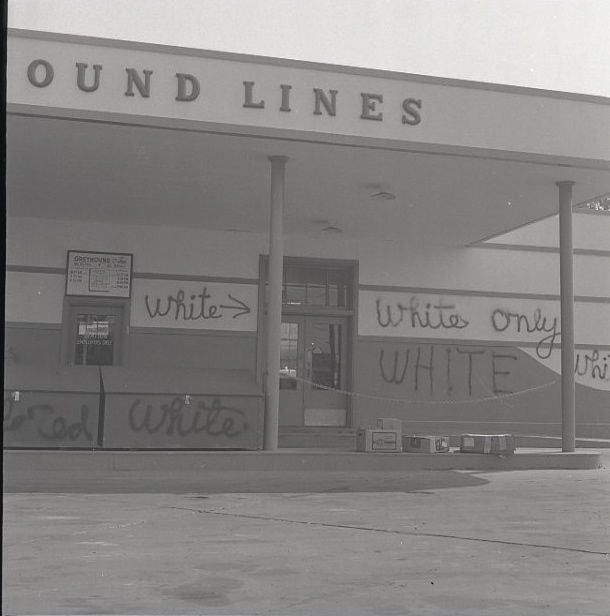
Greenwood's Greyhound Bus Station, photo by Sara Criss

“The Greyhound Bus Station was another target when they did away with their segregated waiting rooms. The station, across the street from City Hall, had paint splattered on it in the dark of night, and on some occasions spray paint was used to indicate they were ‘n—–r lovers.’ De La had let it be known how he felt about the bus station’s policies.

“At one point the City Council passed an ordinance providing that where the Chief of Police considered a situation to exist or to be developing that might lead to a breach of the peace, he might close the place and require everyone to leave. This ordinance was passed on a Sunday afternoon at the height of the Leflore Theater trouble. It provided that should a situation exist on the streets, on the sidewalks or at any public place, or in a store, place of amusement or recreation or in any other business or establishment open to the public ‘which existing or developing situation is likely to lead to a breach of the peace, the chief of police can require all persons in the public place or area to leave and can require the store, place of amusement or recreation to close.’

“The ordinance provided that anyone violating this law would be guilty of a misdemeanor upon conviction and subject to a fine of not more than $300 or imprisonment of not more than 90 days or both. The ordinance also provided that it would take effect immediately after its passage by the council.”

Posted in Uncategorized | Leave a comment

Sara Criss’ Civil Rights Memoir #63: Typed Terror

“The hate sheets continued to be circulated in the night, and various individuals and businesses were the object of their venom. In one, Davis’s a ladies’ dress shop on Howard Street, was attacked in one of the sheets, which said ‘We also have some examples of this type of business operation going on in Greenwood. Davis Apparel Shop on Howard Street seems to prefer colored trade to white trade as their un-necessary salutations to their colored customers indicate that this is so.’ Mr. and Mrs. Davis some time later closed the store and moved back to New Orleans. They were Jewish and had never been too happy here because Jews were excluded from the Country Club, along with Italians, Lebanese, etc. The hate sheet went on: ‘The Otasco store here is another example. The manager of this store is an imported son of the state of Oklahoma. This state is noted for its very segregated Indian reservations. This man’s employment record since coming to Greenwood indicates that he prefers colored labor to white labor and we conclude after observations in his store, that he also prefers colored business to white.’ 

“The Negroes were threatened too in the hate sheet with warnings such as ‘To those of you n—–rs who gave or give aid and comfort to this civil rights scum, we advise you that your identities are in the proper hands and you will be remembered. We know that the n—-r owner of Collins Shoe Shop on Johnson Street “entertained’ Martin Luther King when the “big n——r” came to Greenwood. We know of others and we say to you—-after the shouting and the plate-passing and stupid street demonstrations are over and imported agitators have all gone, one thing is sure and certain. You are still going to be n—–rs and we are still going to be white men. You have chosen your beds and now you must lie in them. You have been duped by the promises of the hate peddlers and freedom destroying Communist propaganda which will place you right back where your ancestors were in communism is allowed to succeed in over-running this country. We warn you that we do not intend to see this happen if it means removing some of you who refuse to listen.’ The sheet was closed with ‘Edited, printed and distributed by a local civic group.'”

Posted in Uncategorized | Leave a comment

Sara Criss’ Civil Rights Memoir #62: Coming to Blows

“The FBI flocked into Greenwood after the Civil Rights Act was signed, and at one point there were nine agents here. They would observe the action at the theater and attempts made by Negroes to enter restaurants, but they were not very aggressive, and from stories that have come out in later years I feel that J. Edgar Hoover was just making a weak effort to make it look as if they were interested in seeing that the law was carried out to the letter.

“The Justice Department too had their men here and they, as a rule, were not the caliber of the FBI men. One, whose name was Rosenberg, was always trying to talk to me. He stayed here longer than any of the other Justice Department representatives. Again, I did not want De La or any of his buddies to see me conversing with Rosenberg. There was a real climate of fear in Greenwood, and in my case I was more afraid of De La and the Klan and Hardy and the Citizens Council than I was of the Negroes.

“When all of our family went to Quitman to Gage and Bill [Roberson]’s wedding that summer [1964], we had to pass through Philadelphia, which was still the center of attention after the disappearance of the three Civil Rights workers. My sister Mary and her husband Howard had come down from Ohio for the wedding and were afraid to drive through there with an Ohio tag on their car so Sheriff George Smith loaned them a Leflore County tag to make the trip. While we were gone that weekend the Mayor and Buff Hammond got into an argument about Gray [Evans] being out of town. He was still City Prosecuting Attorney. When we got back we learned that they had actually passed licks at the City Hall, and Gray and I were always sorry we had missed it because we had seen them almost come to blows before. Charley [Sampson, the Mayor] was furious because Buff would not always go along with him and his ideas on how to handle the situation.”

“[Redacted], the Circuit Clerk, was just like Sampson in that she would not dare make a decision or a statement without Hardy’s approval. She told me one day that they should add statues of Hardy and Stanny to the Confederate monument on the Court House lawn.

Posted in Uncategorized | Leave a comment